

The Classroom of the Future: How Innovative Design Can Enhance the Functionality of School Furniture
Release time:
2024-12-17 15:42
Views:
With the rapid advancement of technology and the transformation of educational approaches, traditional classroom environments are continually evolving. Today’s students are no longer mere recipients of knowledge; they are active participants in their learning, requiring an environment that supports interaction, collaboration, and personalized learning. This calls for school furniture that not only meets basic functional needs but also incorporates innovative features, offering flexibility, comfort, and versatility to better align with the demands of modern education.
With the rapid advancement of technology and the transformation of educational approaches, traditional classroom environments are continually evolving. Today’s students are no longer mere recipients of knowledge; they are active participants in their learning, requiring an environment that fosters interaction, collaboration, and personalized instruction. This calls for school furniture that not only meets basic functional needs but also incorporates innovative features, offering flexibility, comfort, and versatility to better align with the demands of modern education.
1. Modular Design: Flexibility and Adaptability
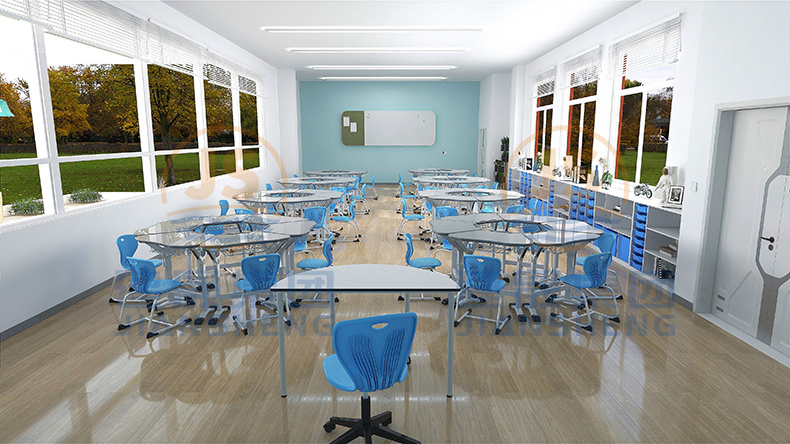
Traditional school furniture is typically fixed in a specific location, making it difficult to adapt flexibly to different teaching activities. Innovative modular designs break this limitation. By designing desks, chairs, storage cabinets, and other school furnishings as detachable, reconfigurable modules, teachers can easily adjust the spatial layout to meet classroom needs. Whether for collaborative projects, small-group discussions, or independent study, these innovative pieces of furniture foster greater cooperation and interaction among students. With tables and chairs arranged in circular or semi‑circular configurations, students can engage more readily in group discussions and teamwork. This not only moves beyond the conventional rows of desks but also encourages communication and collaboration, helping students learn and grow through mutual exchange.
In addition, furniture equipped with interactive features can further foster collaboration and communication. For example, desks with touchscreens enable students to share information and work together to solve problems, enhancing classroom interactivity and engagement.
2. Ergonomic Design: Enhancing Student Comfort and Health
Traditional school desks and chairs often overlook students’ comfort and health; prolonged poor posture can lead to spinal problems. The innovation in modern school furniture design lies in its emphasis on ergonomics, offering seat and desk heights that align with students’ physical development.
For example, height-adjustable desks and chairs allow students to customize the seat and tabletop positions to suit their stature, promoting proper posture and reducing physical strain. Additionally, chairs with built-in back support can effectively alleviate fatigue associated with prolonged sitting. Through these design features, school furniture not only enhances student comfort but also contributes to improved health.
3. Intelligent Features: The Perfect Fusion of Technology and Education
With advances in smart technology, school furniture is increasingly incorporating intelligent features. New types of school furnishings—such as smart desks and chairs, interactive whiteboards, and integrated power systems—are transforming the classroom landscape.
For example, smart desks and chairs can use built-in sensors to monitor students’ sitting postures, alert them to correct poor posture, and even automatically adjust their height to suit each student’s body type. Meanwhile, the desk’s integrated wireless charging pad and USB ports allow students to conveniently charge their electronic devices during class, ensuring they stay fully connected to the lesson content at all times.
In addition, desks equipped with touchscreens can be connected to interactive whiteboards or projection devices, enabling students to engage in hands-on learning directly on the surface and enhancing classroom participation and interactivity. Through such technological innovation, school furniture not only fulfills the traditional functions of conventional furnishings but also delivers a smarter, more efficient teaching experience for both students and teachers.
4. Environmental Protection and Sustainable Development: Applications of Green Design
As environmental awareness continues to grow, modern school furniture is placing increasing emphasis on material selection and the sustainability of production processes. Innovative design is reflected not only in functionality but also in environmental protection and energy efficiency.
For example, an increasing number of school furniture pieces are now made with renewable materials and eco-friendly coatings, reducing the use of harmful substances and safeguarding students’ health. At the same time, furniture designs place greater emphasis on material durability, minimizing resource overconsumption and extending the lifespan of the furnishings. Green design not only helps schools cut costs but also fosters the widespread adoption of environmental sustainability principles in education.
5. Multifunctional Design: Dual Optimization of Space and Storage
In limited classroom spaces, multifunctional furniture maximizes space utilization. Innovatively designed school furniture often integrates multiple functions, such as foldable desks and chairs, desktops with built-in storage, and mobile bookshelves.
For example, some desks and chairs are designed with built-in storage compartments, allowing students to keep their books, stationery, and personal items organized and their desks tidy. This design not only saves classroom space but also helps students develop good organizational habits. Moreover, wheeled furniture can be easily moved, enabling teachers to rearrange seating according to instructional needs and enhancing teaching flexibility.
The design of the classroom of the future is not merely a simple upgrade of the traditional learning environment; it represents a profound shift in educational philosophy. Through innovative design, school furniture can offer more flexible and comfortable learning spaces, while also providing students and teachers with more efficient, smarter educational tools. As these innovative designs continue to evolve, we have every reason to believe that tomorrow’s classrooms will be brimming with vitality, becoming true learning environments that meet the demands of modern education.
Through thoughtfully designed school furniture, we can not only provide students with a healthier, more comfortable learning environment but also offer teachers greater instructional support, thereby advancing and enriching the field of education.

School furniture
Related News

News
Winning Project
Beyond Manufacturing: A Showcase of JianSheng Group’s Domestic Project Winning Achievements in 2026
2026-08-24

News
Corporate News
Charitable Education Support | The Nanjing County Charity Federation, in collaboration with Jiansheng Group, has donated a batch of student dormitory beds to Longshan Middle School in Nanjing County.
2026-08-24

Delivery News
Office Furniture
Jiansheng Group | Turnkey Office Furniture Solution Delivery Case for Fujian Kenuo Science and Technology Park
2026-08-20
