

New Trends in the Design of University Lecture Hall Chairs
Release time:
2025-05-12 17:00
Views:
With the evolution of modern educational models, the comfort and functionality of learning environments have come to be increasingly valued. In particular, within university classrooms, students’ learning efficiency and overall experience depend not only on the quality of instructional content but also on the thoughtful design of the classroom space. In recent years, tiered lecture halls have gradually become the mainstream in higher education, and “tiered chairs,” as a key component of this classroom design, are steadily reshaping the traditional classroom landscape. I. Design Background and Significance of Tiered Chairs As the name suggests, tiered chairs are seating arrangements featuring stepped tiers. Their design draws inspiration from the seating layouts of large lecture halls and theaters, aiming to provide every student with an unobstructed view of the podium and whiteboard through a hierarchical seat configuration. Unlike conventional flat‑row seating, tiered chairs excel in their carefully engineered viewing angles, offering students not only superior visual clarity but also enhancing their sense of participation in classroom interactions. In universities—especially in large‑enrollment courses—traditional seating arrangements often fail to ensure that every student enjoys a clear line of sight. By contrast, tiered chairs address this issue through a staggered, front‑to‑back seating arrangement, significantly improving the overall learning experience. II. Functions and Advantages of Tiered Chairs Enhanced Visibility
With the evolution of modern educational models, the comfort and functionality of learning environments have come to be increasingly valued. In particular, in university classrooms, students’ learning efficiency and overall experience depend not only on the quality of the instructional content but also on the spatial design of the classroom. In recent years, tiered lecture halls have gradually become the norm in higher education, and “tiered seating,” as a key element of this classroom design, is steadily reshaping the traditional classroom landscape.
I. Design Background and Significance of the Step Stool
A tiered chair, as its name suggests, is a chair equipped with stepped seating. Its design draws inspiration from the seating arrangements of large lecture halls and theaters, aiming to ensure that every student has an unobstructed view of the podium and whiteboard through a multi-level seating layout. Unlike traditional flat‑row seating, the distinctive feature of tiered chairs lies in their carefully engineered viewing angles, which not only provide students with a superior visual experience but also enhance their sense of participation in classroom interactions.
In higher education institutions, particularly in large‑class courses, traditional seating arrangements often fail to provide every student with an unobstructed view. In contrast, tiered seating, with its staggered arrangement of seats, effectively addresses this issue, significantly enhancing the learning experience for students.
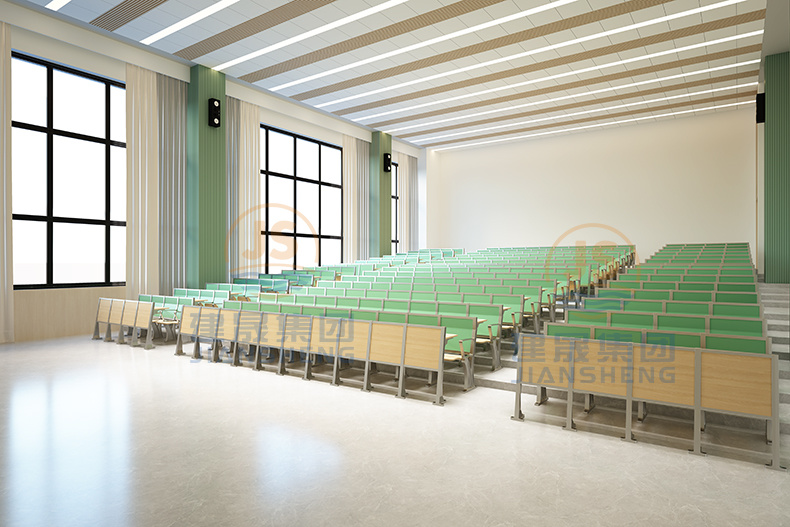
II. Functions and Advantages of the Step Stool
Enhance visibility and interactivity
The clear advantage of tiered seating is that it provides an excellent view. Each row ensures that students, regardless of where they sit, can clearly see the podium or the screen. This design not only enhances teaching quality but also boosts students’ sense of engagement in class. Students no longer lose focus due to their seat location, and interactions between teachers and students become smoother.
Space-saving
As student enrollment grows, traditional classrooms often become overcrowded. Stair‑step seating is designed to make the most of vertical space; by arranging seats in tiers, it maximizes classroom capacity. Without expanding the floor area, stair‑step chairs can accommodate more students, making them especially well suited for large‑scale lectures and classroom instruction.
Enhance the learning experience
Step stools are more than just functional seating; many contemporary designs also prioritize comfort and user‑friendliness. For instance, they often feature adjustable backrests, cushioned seats, and convenient trays for holding books, significantly enhancing students’ learning comfort. Moreover, the stepped arrangement creates greater spacing between students, alleviating the cramped feeling associated with traditional seating layouts.
Promote diversified teaching models
The design of tiered seating is not only well-suited to traditional lecture‑based instruction but also supports a variety of teaching approaches, such as small‑group discussions and interactive exchanges. In some classrooms, instructors can incorporate interactive activities, making student‑to‑student communication even more convenient. The stepped arrangement of seats offers improved sightlines and ample space, enabling greater flexibility and diversity in instructional practices.

III. Challenges and Improvements of Step Stools
Although step stools play an important role in modern classrooms, their design and use also face certain challenges. First is the issue of comfort: prolonged sitting on a step stool can lead to discomfort for students. To address this, many universities are placing greater emphasis on ergonomics when selecting step stools, ensuring that they better accommodate students’ body types and usage habits.
Secondly, the maintenance and cleaning of step stools have also become tasks that cannot be overlooked. Due to their relatively complex structure, these stools are comparatively difficult to clean and maintain. To address this issue, many universities have opted for more durable, easy-to-clean materials and have designed them with features that facilitate disassembly and repair.
Overall, as an essential component of university classroom design, tiered seating plays a significant role in enhancing the quality of instruction, optimizing space utilization, and improving students’ learning experiences. With the continuous evolution of educational philosophies and advances in technology, future tiered seating is likely to place greater emphasis on smart features, comfort, and environmental sustainability. For higher education institutions, how to balance functional requirements with aesthetic appeal and user‑centered design remains a promising area for further exploration.
Founded in 2003, Jiansheng Group is a global provider of mid-to-high‑end commercial furniture solutions. With education furniture at its core, the company also serves key market segments such as office furniture and healthcare‑and‑senior‑care furnishings. Its industrial park boasts a manufacturing footprint of 150,000 square meters. Committed to fostering superior learning, working, and healthcare environments, Jiansheng has, over 22 years of operation, exported to 132 countries and regions and supplied school furniture to the education ministries of more than 30 nations. The company’s product portfolio includes K‑12 and university student desks and chairs, nap‑time tables and chairs, tiered classroom furniture, smart classroom solutions for higher education, multi‑functional classroom equipment, apartment‑style beds, dining tables and chairs, kindergarten and school furniture, library furnishings, office furniture, and senior‑care furniture, among others.
University tiered seating
Related News

News
Winning Project
Beyond Manufacturing: A Showcase of JianSheng Group’s Domestic Project Winning Achievements in 2026
2026-08-24

News
Corporate News
Charitable Education Support | The Nanjing County Charity Federation, in collaboration with Jiansheng Group, has donated a batch of student dormitory beds to Longshan Middle School in Nanjing County.
2026-08-24

Delivery News
Office Furniture
Jiansheng Group | Turnkey Office Furniture Solution Delivery Case for Fujian Kenuo Science and Technology Park
2026-08-20
