

An Exploration of the Evolution of Desks and Chairs and Desk Styles Among Junior College Students in Their Academic Lives
Release time:
2025-07-23 10:45
Views:
With the passage of time and societal development, the learning environment for vocational college students has undergone continuous evolution. Changes in the style of desks, chairs, and study tables not only reflect updates in educational philosophies but also underscore a growing emphasis on comfort and functionality. From traditional, single‑purpose desks and chairs to modern, personalized designs, shifts in design, materials, functionality, and aesthetics have profoundly influenced students’ academic performance, physical health, and psychological well-being. I. Traditional Desks and Chairs: Functionality First, Simple and Practical Under the conventional education model, desk and chair designs were relatively straightforward, prioritizing basic functionality—providing a stable seat that could support prolonged study. Typically made of wood, these pieces featured fixed shapes and limited variety. Most desks lacked additional storage space, serving primarily as flat surfaces for writing and holding textbooks, while seating comfort was seldom a major concern. Characteristics: • Limited Materials: Predominantly constructed from wood or metal frames, with simple structures that did not account for ergonomic principles. • Strong Functional Focus: Design centered on meeting students’ fundamental learning needs; desks often offered ample surface area but paid little attention to comfort. • Unadorned Simplicity
As times have changed and society has evolved, the learning environment for vocational‑college students has undergone continuous transformation. The shifting styles of desks, chairs, and study tables not only reflect evolving educational philosophies but also underscore a growing emphasis on comfort and functionality. From traditional, one‑size‑fits‑all desks and chairs to modern, personalized designs, changes in their form, materials, features, and aesthetics have far‑reaching implications for students’ academic performance, physical well‑being, and mental health.
I. Traditional Desks and Chairs: Function First, Simple and Practical
Under the traditional education model, desk and chair designs are relatively simple, focusing primarily on basic functionality—providing a stable seat that can support students during extended periods of study. Conventional desks and chairs are typically made of wood, with fixed shapes and rather uniform designs. Most desks lack additional storage space, serving merely as flat surfaces for writing and holding textbooks, while the comfort of the chairs is seldom given much consideration.
Features:
Single-material construction: primarily wood or metal frames, with a relatively simple structure that does not take ergonomic considerations into account.
Highly functional: The design of desks and chairs prioritizes meeting students’ basic learning needs, often featuring spacious desktops but with limited attention to comfort.
A minimalist style: The desks and chairs prioritize functionality, with simple, unadorned designs and color schemes that favor natural wood tones or monochromatic palettes.
Although this design is simple and practical, prolonged sitting at desks and chairs that are not sufficiently comfortable can lead to fatigue, compromising both learning efficiency and physical health—particularly for vocational‑college students, who often spend long hours at their desks.
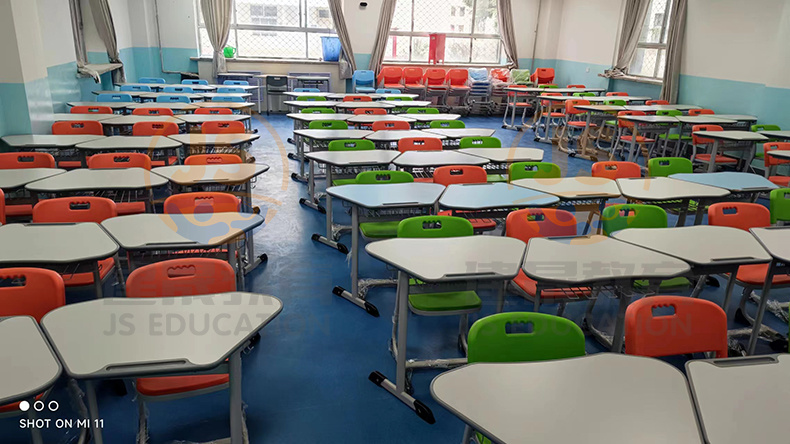
II. Ergonomic Design: Balancing Comfort and Health
As attention to students’ physical and mental well-being continues to grow, ergonomic principles have increasingly been incorporated into the design of desks and chairs. Ergonomically designed furniture can help alleviate the discomfort associated with prolonged sitting, such as pressure on the spine and cervical vertebrae. Particularly for vocational‑college students who spend long hours studying, the comfort of their desks and chairs has become especially critical.
Features:
Ergonomic Design: The height, angle, and backrest of the desk and chair are designed to accommodate the body’s natural curves, ensuring students maintain proper posture while studying.
Enhanced comfort: The seat cushion offers adjustable firmness, the backrest provides enhanced support, and the desk height is adjustable to meet the diverse needs of students.
Functional Design: Modern desks and chairs often come with storage compartments, helping students organize their school supplies, minimize clutter, and boost productivity.
Ergonomic design not only enhances students’ comfort but also effectively reduces health issues, particularly by alleviating strain on the spine, cervical region, and lower back during extended periods of study.
III. Multifunctional Desks and Chairs: A Blend of Personalization and Practicality
As society places greater emphasis on students’ individualized needs, multifunctional, customizable desks and chairs are increasingly making their way into the education sector. Particularly in modern vocational and technical education, the learning environment must not only prioritize comfort and health but also accommodate personalized and multifunctional requirements.
Features:
Multifunctional Design: School desks and chairs typically feature adjustable desktops, with some models offering flip‑over or foldable configurations for greater flexibility. Certain sets also come with adjustable seats and tabletops, accommodating students’ varying postures and diverse usage needs.
Personalized Style: Desks and chairs come in a wider variety of colors, shapes, and styles. Modern design emphasizes individuality, allowing students to choose furniture that reflects their interests and preferences, thereby enhancing the enjoyment and motivation of learning.
Modular Design: Some desks and chairs feature a modular design, allowing them to be reconfigured to meet diverse instructional needs. For example, students can adjust the height of their desks and chairs, or combine multiple units to create group‑learning tables, thereby enhancing collaboration and interaction.
This design allows students not only to study in a comfortable environment but also to tailor their learning experience to their individual needs, thereby enhancing both flexibility and efficiency.

IV. Future Trends: Intelligentization and Eco-Friendly Design
With advances in technology, smart features and eco-friendly design are increasingly shaping the future of school desks and chairs. In tomorrow’s vocational education settings, these furnishings will become even more intelligent, automatically adjusting height, tilt, and other parameters to suit students’ individual preferences and deliver an optimal learning experience. Moreover, as environmental awareness grows, more schools and designers are incorporating sustainable materials into desk and chair designs, helping to minimize their ecological footprint.
Features:
Intelligent features: The desks and chairs are equipped with sensors that monitor students’ sitting posture, prompt them to adjust it, and even track their study duration and activity levels, helping them develop healthy study habits.
Eco-friendly materials: In contemporary desk and chair designs, recyclable materials are increasingly being used to minimize environmental impact while maintaining durability and comfort.
Personalized customization: In the future, desks and chairs will be tailored to students’ height, body type, study habits, and other personalized data, delivering an optimal learning experience.
The evolution of desks and chairs for vocational college students reflects a gradual shift in educational philosophy—moving from simple functional design to an emphasis on ergonomic comfort, and ultimately to the promotion of multifunctional, personalized solutions. This progression underscores education’s growing focus on students’ health, learning efficiency, and psychological well-being. As technology advances and societal expectations for the learning environment rise, desk and chair designs will become increasingly intelligent and environmentally sustainable, aiming to provide students with a more comfortable, healthier, and more productive learning space.
Founded in 2003, Jiansheng Group is a global provider of mid-to-high‑end commercial furniture solutions. With education furniture at its core, the company also serves key market segments such as office furniture and healthcare‑and‑senior‑care furnishings. Its industrial park boasts a manufacturing footprint of 150,000 square meters. Committed to fostering superior learning, working, and healthcare environments, Jiansheng has, over its 22 years of operation, exported to 132 countries and regions and supplied school furniture to the education ministries of more than 30 nations. The company’s product portfolio includes K‑12 and university student desks and chairs, nap‑time tables and chairs, tiered classroom furniture, smart classroom solutions for higher education, multi‑functional classroom equipment, apartment‑style beds, dining tables and chairs, kindergarten and school furniture, library furnishings, office furniture, and senior‑care furniture, among others.
Specialty student desks and chairs
Related News

News
Winning Project
Beyond Manufacturing: A Showcase of JianSheng Group’s Domestic Project Winning Achievements in 2026
2026-08-24

News
Corporate News
Charitable Education Support | The Nanjing County Charity Federation, in collaboration with Jiansheng Group, has donated a batch of student dormitory beds to Longshan Middle School in Nanjing County.
2026-08-24

Delivery News
Office Furniture
Jiansheng Group | Turnkey Office Furniture Solution Delivery Case for Fujian Kenuo Science and Technology Park
2026-08-20
